Baofeng UV-5R
The disposable, all-inclusive starter kit for modern ham radio — a $25–$35 learner’s permit, not a lifetime shack investment.
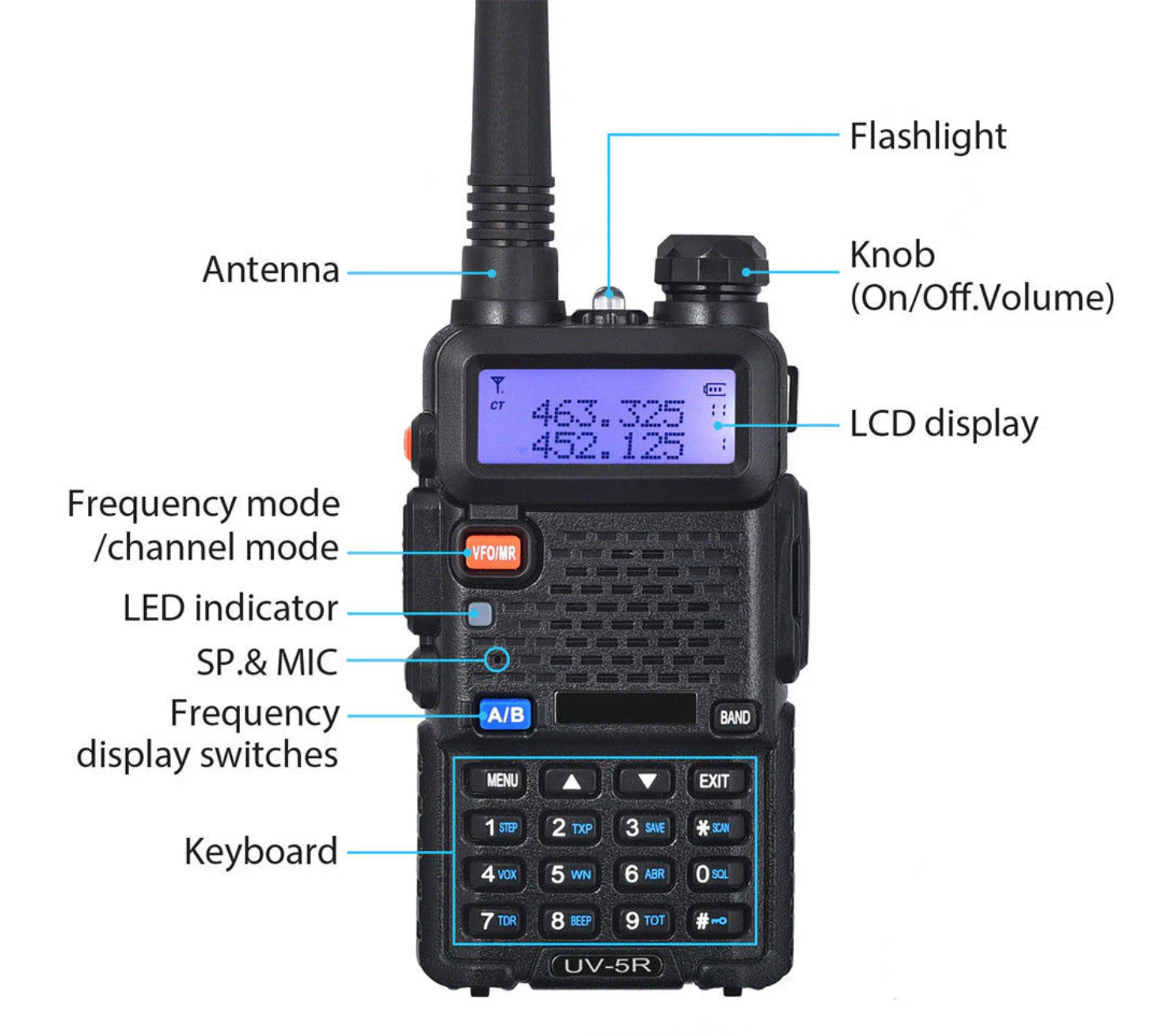
- Complete kit for $25–$35 — charger, battery, earpiece included
- Low-risk way to learn programming & repeater offsets
- Massive community support & CHIRP compatibility
- Surprisingly loud audio for its size
- Dual-watch lets you monitor two frequencies at once
- Weak front-end filtering — prone to receiver desense
- Stock antenna is nearly a dummy load
- Keypad programming is clunky and unintuitive
- Build quality well below Yaesu/Icom/Alinco tier
| Bands | 2m (144–148 MHz) / 70cm (420–450 MHz) |
|---|---|
| Output Power | 4W high / 1W low (commonly marketed as “5W”) |
| Channels | 128 programmable memory channels |
| Battery | 7.4V 1800mAh Li-ion |
| Antenna Connector | SMA-Female |
| Programming | Keypad, CHIRP (free/open-source), or manufacturer PC software |
| In the Box | HT body, battery, belt clip, wrist strap, desktop charging cradle, wall adapter, earpiece/mic |
| Typical Price | $25–$35 |
| Best Use Case | Learner radio, glove-box backup, go-kit “beater” rig |
The Verdict First
Let’s be entirely honest: the Baofeng UV-5R is not a high-performance piece of engineering. If you judge it strictly alongside a Japanese-engineered rig from Yaesu, Icom, or Alinco, its technical performance falls flat.
However, as a $25 to $35 all-inclusive package, it serves a vital purpose in amateur radio. It is the ultimate low-risk “learner’s permit” radio. It allows a newly licensed ham to learn the ropes of programming, repeater offsets, and basic HT operation without dropping hundreds of dollars on day one. Just keep your expectations firmly in check — it is a cheap, entry-level tool, not a lifetime shack investment.
1. What’s in the Box: An Unbeatable Starter Bundle
One of the most impressive aspects of the Baofeng UV-5R platform is just how much gear they manage to pack into a dirt-cheap box. When you buy one, you aren’t just getting a bare radio — you are getting a complete, ready-to-operate station kit:
- The Essentials: The dual-band HT body, a standard lithium-ion battery, a belt clip, and a wrist strap.
- The Charging Infrastructure: Unlike many high-end radios that make you buy accessories separately, Baofeng includes a dedicated drop-in desktop charging cradle and the wall power adapter right out of the box.
- The Extras: Most standard kits also throw in a basic clip-on earpiece/microphone headset, allowing for hands-free operation right away.
2. The Positives: The Perfect “Trainer” Radio
For a newly licensed Technician, jumping straight into a complex, menu-heavy Japanese radio can be daunting and financially restrictive. The UV-5R is a fantastic stepping stone. It forces you to learn how frequency shifts, CTCSS/DCS tones, and simplex vs. duplex operations work. If you accidentally brick the configuration or drop the radio on the concrete, you are only out $25, making it completely stress-free to learn on.
Because millions of these radios exist, you are never alone. Every single menu setting, quirk, and workaround has a dozen YouTube tutorials explaining how it works. Best of all, it integrates seamlessly with the open-source CHIRP software. Once you plug in a programming cable, you can download your entire local repeater directory and flash the radio in under two minutes.
For its size, the audio output is incredibly loud. On the 2-meter and 70-centimeter bands, the output is entirely sufficient for hitting local repeaters cleanly with full-quieting reports if you have a decent line of sight. The dual-watch feature also lets you monitor a local club repeater on VFO A while keeping an eye on a simplex calling frequency on VFO B.
3. The Cons: Where the Cheap Price Shows
This is the radio’s biggest technical flaw: because it uses an inexpensive direct-conversion chip rather than a traditional superheterodyne receiver, the front end is incredibly wide open. If you operate it near modern LED lighting, computer RFI, or massive commercial radio towers, the receiver will easily become overwhelmed (“desensitized”) and go completely deaf, missing calls that a Yaesu or Icom would pull in effortlessly.
- The Stock Antenna is Essentially a Dummy Load: The included “rubber duck” antenna is notoriously inefficient, particularly on the 2-meter band. It is highly recommended that you budget an extra $15 for a genuine aftermarket antenna (like a Nagoya NA-771) to instantly improve your real-world receive and transmit range.
- Cumbersome Keypad Programming: While learning the manual programming method is great for educational purposes, doing it via the faceplate is an exercise in frustration. The menu structure is counter-intuitive, and entering alphanumeric alpha-tags for channels directly from the keypad is practically impossible.