Cushcraft/MFJ AR270B Dual-Band Ringo
The low-angle DX powerhouse for 2m and 70cm — a compact aluminum vertical that punches well above its 7.7-foot height.
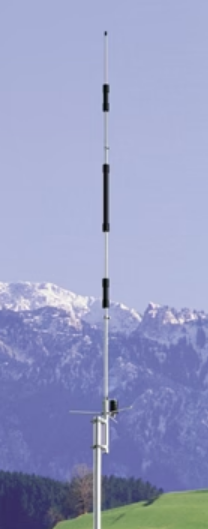
- Exceptional simplex range from a hard, low radiation angle
- 5.5 dBi / 7.5 dBi gain — pulls weak DX out of the noise floor
- Wide 2:1 SWR bandwidth on both bands
- Compact 7.7-ft profile with a tiny 6.75-in radial footprint
- Sealed coils resist moisture and weather-induced detuning
- Not plug-and-play — needs careful tuning with an analyzer
- Stock hose-clamp mounting hardware is basic
| Bands | 144–148 MHz / 430–450 MHz |
|---|---|
| Design | Computer-optimized collinear dual-band vertical |
| Elements | Two 5/8‑wave on 2m, four 5/8‑wave on 70cm |
| Gain | 5.5 dBi (2m) / 7.5 dBi (70cm) |
| Height | 7.7 ft (2.35 m) |
| Weight | 2.4 lbs |
| Power Rating | 250W |
| VSWR | 1.2:1 typical; 2:1 bandwidth >4 MHz (2m), >15 MHz (70cm) |
| Wind Load | 0.47 sq. ft. |
| Radial Footprint | 6.75-in radials |
| Connector | SO‑239 (UHF female) |
| Mount | Clamp-on mast mount |
| Manufacturer | Cushcraft / MFJ Enterprises ↗ |
The Verdict First
The Cushcraft AR270B is an absolute powerhouse of an omnidirectional base antenna. Rated at an impressive 5.5 dBi on 2 meters and 7.5 dBi on 70 centimeters, this 7.7-foot aluminum vertical is engineered with a hyper-focused, low angle of radiation.
If you are trying to cut through rough, mountainous terrain, pull weak signals out of the mud, or stretch past typical simplex limits, this is the antenna that does it. It transforms a standard VHF/UHF station into a serious long-distance ears-and-voice setup without needing a massive directional beam tower.
1. Physical Profile & Technical Build
- The Elements: The AR270B utilizes a computer-optimized collinear design featuring two 5/8-wavelength elements on 2 meters and four 5/8-wavelength elements on 70 centimeters.
- The Chassis: Constructed from three rugged aluminum tubing sections, it features factory-sealed coils to lock out moisture and prevent the dreaded weather-induced impedance shifts common in cheaper fiberglass “white sticks.”
- Radials & Footprint: With a tiny radial footprint (6.75-inch radials) and a total weight of just 2.4 lbs, it packs a massive RF punch into a highly compact, low-wind-load design.
2. Real-World Performance (Why It Rips)
Because the AR270B squashes the RF pattern down hard toward the horizon rather than wasting energy shooting up into the sky, its real-world simplex performance is staggering. Operating from a high-altitude mountain base — like the foot of Mt. Baldy — this antenna has the raw efficiency to punch a crystal-clear 146.52 MHz FM simplex signal all the way down to San Diego.
The true magic of the “B” model Ringo is its ears. The extra gain makes it a phenomenal DX tool, pulling in distant, weak signals that standard ground planes completely miss. If there is a localized tropospheric opening or a distant station attempting a simplex contact, the AR270B brings them fully out of the static floor.
You don’t have to choose between the low end of the weak-signal band or the top end of the repeater splits. The AR270B features a wide 2:1 SWR bandwidth (>4 MHz on VHF, >15 MHz on UHF), giving you flat, predictable tuning across both bands.
3. Points to Consider
Because it is an adjustable aluminum Ringo antenna rather than a pre-tuned, plug-and-play fiberglass rod, getting your SWR perfectly dialed in during assembly requires following the manual measurements carefully and using an antenna analyzer.
While the rugged aluminum sections handle heavy winds beautifully, the stock mast mounting hardware relies on basic hose-clamp style brackets. It works perfectly fine, but adding a set of heavy-duty U-bolts is a common shack upgrade for peace of mind in high-wind zones.